Eighteen minutes is roughly the length of one cartoon episode. In a Canadian study of elementary school children, that small amount of extra sleep each night was linked to better report card grades in math and English.
The study, published in Sleep Medicine in May 2016, tested a school-based program called "Sleep for Success." The goal was to see whether teaching children and families about sleep could change how much kids actually slept, and whether that would show up in their schoolwork.
This post explains what the researchers did, what they found, and where the study has limits. It also covers why sleep matters so much for children ages 7 to 11. Most importantly, it offers practical bedtime tips and simple at-home activities that help kids build healthy sleep habits.
What the Sleep for Success Study Looked At
The study was led by Dr. Reut Gruber and a team of researchers from McGill University and the Douglas Mental Health University Institute in Montreal. They built the program together with educators and families from the Riverside School Board in Quebec.
Sleep for Success was not just a single lesson. It included four parts, each aimed at a different group:
- Children, through a six-week classroom curriculum about sleep
- Families and the community, with tools to get parents involved at home
- School staff, so teachers could support the message
- School decision makers, to help sleep education fit into the school setting
The program ran in three elementary schools. Children in the study were between 7 and 11 years old, and all were healthy and typically developing. Children with sleep disorders, learning disabilities, or certain medical conditions were not included.
How Sleep Was Measured
Many earlier sleep studies relied on what parents or children reported. This one used actigraphy, a small wristwatch-like device that tracks movement to estimate when a child falls asleep, wakes up, and how restful the night is. It gives a more objective picture than memory or guesswork.
To measure school performance, researchers used real report card grades. They compared results before and after the program in two groups: children who took part in Sleep for Success (the intervention group) and children who did not (the control group).
The Key Findings at a Glance
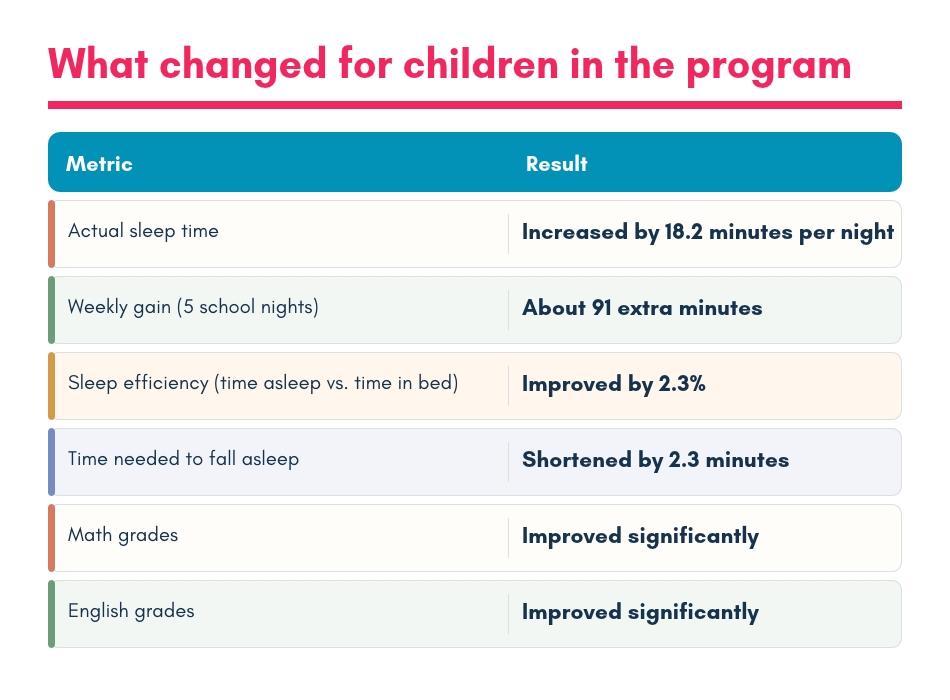
In the control group, none of these measures changed.
Here's the key takeaway: the improvements didn't come from a dramatic overhaul. Children slept a little longer, slept a little more soundly, and fell asleep a little faster. Together, those small gains were associated with better grades.
Why 18 Minutes Is More Meaningful Than It Sounds
On a single night, 18 minutes looks minor. Over a school week, it adds up to about an hour and a half of extra rest. Over a full school term, that becomes many hours of additional sleep.
Sleep efficiency matters too. A child who spends 10 hours in bed but tosses and turns may get less real rest than a child who sleeps soundly for 9.5 hours. The study showed that both quantity and quality improved. That combination is where the program really shines.
Why Sleep Matters for School-Age Children
Children between 7 and 11 are at a stage where learning moves fast. They're mastering reading, building math skills, following multi-step directions, and managing friendships. All of this depends on a brain that's well rested.
Pediatric sleep experts generally recommend 9 to 12 hours of sleep per night for children ages 6 to 12. The study authors pointed to about 10 hours as a healthy target. Yet the research they cited showed that many elementary school children sleep closer to 8 hours a night.
Another finding the authors highlighted: in a large survey, 27% of school-age children were getting less sleep than their own parents thought they needed. In other words, many families already sense the gap but find it hard to close.
How Sleep Supports Memory
During sleep, the brain sorts and stores what a child learned during the day. Spelling words, times tables, and new vocabulary all get "filed away" overnight. When sleep is cut short, some of that filing doesn't happen as well.
This is one reason a child may seem to know something perfectly on Tuesday evening and then struggle with it on a Wednesday morning quiz after a late night.
How Sleep Affects Attention
Tired children often have a harder time focusing. They may drift off during lessons, miss instructions, or need things repeated. Interestingly, sleepy kids don't always look sleepy. Some become more restless, fidgety, or distracted instead of yawning.
How Sleep Shapes Executive Function
Executive function is the brain's management system. It covers skills like planning, staying organized, controlling impulses, and switching between tasks. These skills play a big role in math, where children need to hold numbers in mind and follow steps in order.
Research has linked short or poor-quality sleep to weaker executive function. That connection helps explain why math grades may respond to better sleep.
Why This Age Group Is a Good Place to Start
The researchers chose to focus on younger children for practical reasons. At this age:
- Sleep loss often comes from habits and routines, such as late bedtimes, rather than the body-clock shifts that arrive with puberty
- Children are more open to guidance from parents and teachers than teenagers usually are
- Habits formed early tend to stick, which may make the teenage years a bit easier
What this means for you: the elementary years are a window where your bedtime routines have strong influence. Changes you make now can carry forward.
Signs Your Child May Need More Sleep
Not every tired child is obviously tired. Watch for patterns like these:
- Hard to wake up on school mornings, or needs several reminders
- Falls asleep in the car on short trips
- Moody, irritable, or quick to cry in the late afternoon
- Trouble concentrating on homework
- Sleeps much longer on weekends than on school nights
- More restless or "wound up" in the evening
One or two of these on occasion is normal. If several show up most days, it may be worth looking at bedtime and sleep habits. If your child snores loudly, stops breathing briefly during sleep, or seems exhausted despite enough time in bed, talk with your pediatrician.
Keeping the Findings in Perspective
This study offers encouraging results, but it's worth being clear about what it can and can't tell us.
- It was a small study. Around 70 children completed all the measurements, out of 192 who took part in program activities.
- Groups weren't randomly assigned. That means other differences between groups could have played a role.
- It shows an association, not proof of cause. Better sleep and better grades moved together, but the study can't fully rule out other factors.
- Participants were healthy children. Results may differ for children with sleep disorders or learning challenges.
Still, the study had real strengths. It used objective sleep tracking and actual report card grades, which many earlier programs didn't. According to the authors, it was the first school-based sleep program for elementary students to document longer sleep using objective measures.
Overall, the findings are worth taking seriously, especially since the steps involved are low-cost, low-risk, and good for children's health in other ways too.
Building a Bedtime Routine That Works
The Sleep for Success program focused on habits and education, and much of that can happen at home. A consistent routine is one of the most effective tools parents have.
Step 1: Set a Consistent Bedtime
Work backward from wake-up time. If your child needs to be up at 7:00 a.m. and you're aiming for about 10 hours, lights-out should be around 9:00 p.m. Keep bedtime within 30 to 60 minutes on weekends too, so the body clock stays steady.
Step 2: Start Winding Down 30–60 Minutes Before Bed
Children rarely go from active play to sleep in one jump. A wind-down period signals that the day is ending. Dim the lights, lower the noise, and shift to calm activities.
Step 3: Keep the Same Order Every Night
Predictability helps children relax. A simple sequence works well:
- Bath or shower
- Pajamas
- Brush teeth
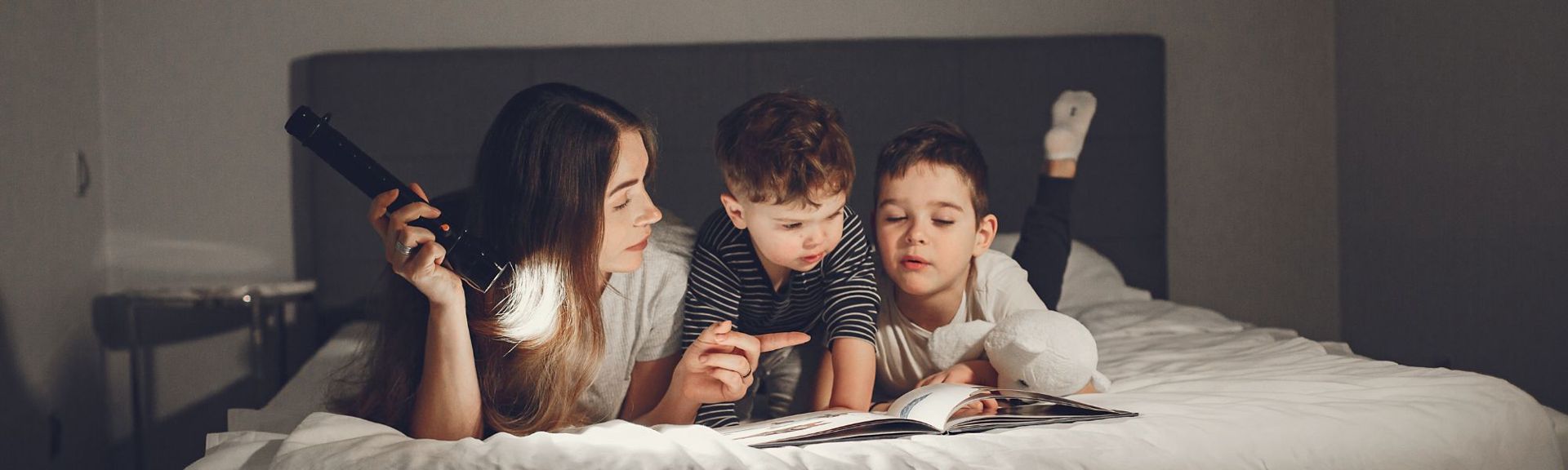
- Story or quiet reading
- A short chat or cuddle
- Lights out
Step 4: Move Screens Out Early
Phones, tablets, and video games keep the brain alert, and bright screens can delay the body's natural sleepiness. Aim to switch off screens at least an hour before bed, and keep devices out of the bedroom overnight.
Step 5: Create a Sleep-Friendly Bedroom
A good sleep space is:
- Cool, slightly cooler than daytime rooms
- Dark, with blackout curtains if streetlights or early sunrise are an issue
- Quiet, or with gentle background noise like a fan
- Calm, with toys and homework put away
Step 6: Watch Food, Drinks, and Timing
Large meals, sugary snacks, and caffeinated drinks (including some sodas and iced teas) close to bedtime can make it harder to fall asleep. A light snack is fine if your child is genuinely hungry.
Micro-summary: consistency matters more than perfection. The same bedtime, the same steps, and a calm environment do most of the work.
Simple At-Home Activities to Build Healthy Sleep Habits
Children are more likely to embrace good sleep when they understand it and feel involved. These activities turn sleep into something to explore together, not just a rule to follow.
Make a Family Sleep Diary
For one or two weeks, have your child record bedtime, wake-up time, and how they felt the next day using a simple scale or smiley faces. Older children can track it themselves. Afterward, look for patterns together: "Did you feel better on days you went to bed earlier?"
This mirrors what the researchers did, just without the wristband. It helps children see the connection for themselves.
Design a Bedtime Routine Chart
Let your child draw or decorate a chart showing each step of the bedtime routine. Younger children can use pictures, while older ones can add checkboxes. When kids help create the plan, they're more willing to follow it.
Explore the Science of Sleep
Children ages 7 to 11 are naturally curious. Try these quick learning moments:
- Read a children's book about why animals and people sleep
- Look up how many hours different animals sleep (a koala sleeps far more than a giraffe)
- Talk about how the brain "saves" what we learn overnight
Understanding why makes bedtime feel less like a punishment.
Set Up a "Device Parking Station"
Choose a spot outside the bedrooms, such as the kitchen counter, where all family devices charge overnight. Let your child decorate a sign for it. When adults use the station too, children see that the rule applies to everyone.
Create a Wind-Down Activity Box
Fill a box with calm activities your child can choose from before bed:
- Coloring pages or a sketchbook
- Simple puzzles
- Picture books or chapter books
- Playdough or modeling clay
- A small journal for writing or drawing about the day
Having a set of quiet options makes the switch from active play easier.
Practice Relaxation Games
Short relaxation exercises help children who struggle to settle down:
- Balloon breathing: breathe in slowly to "fill a balloon" in the belly, then let it out slowly
- Body scan: tense and relax each body part, starting with the toes and moving up
- Quiet imagination: describe a calm place, like a beach or a forest, in as much detail as possible
These are especially useful for children whose minds race at bedtime.
Get Morning Light and Daytime Movement
Good sleep starts in the morning. Natural light soon after waking helps set the body clock. Physical activity during the day, such as biking, playing outside, or walking to school, also makes it easier to fall asleep at night. Just avoid very energetic play right before bed.
Common Mistakes to Avoid
Even with good intentions, a few habits can work against healthy sleep.
Letting Weekend Bedtimes Drift Too Far
Staying up two or three hours later on Friday and Saturday can make Monday mornings much harder. A small shift is fine. A large one works like mild jet lag.
Using Bedtime as a Punishment
Sending a child to bed early as a consequence can create negative feelings around sleep. It's better to keep bedtime neutral and positive.
Overscheduling Evenings
Late practices, lessons, and homework can push bedtime back night after night. One of the downsides of a packed schedule is that sleep is often the first thing cut. If evenings regularly run late, consider trimming one activity.
Assuming Kids Will "Catch Up" on Sleep
Sleeping in on weekends helps a little, but it doesn't fully make up for a week of short nights. Steady, nightly sleep is what supports learning.
Quick Checklist for Better Sleep
Use this list to check where your family stands:
- Bedtime allows about 9–12 hours of sleep
- Bedtime stays similar on weekends
- Screens go off at least an hour before bed
- Devices charge outside the bedroom
- The bedroom is cool, dark, and quiet
- A calm wind-down routine happens most nights
- Your child gets daylight and movement during the day
- Caffeine and heavy snacks are avoided in the evening
You don't need to tick every box right away. Start with one or two changes and build from there.
Conclusion: Small Changes, Real Results
The Sleep for Success study showed that children who slept just 18.2 minutes more per night, with slightly better sleep quality, saw significant gains in math and English grades. Children who didn't take part saw no change. The study had limits, but its message is practical and easy to act on.
For children ages 7 to 11, sleep supports memory, attention, and the planning skills that schoolwork depends on. Consistent bedtimes, calm routines, and fewer screens at night are simple tools any family can use.
A good first step this week: try moving bedtime 15 to 20 minutes earlier and keep a simple sleep diary with your child for two weeks. Notice how mornings, mood, and homework time change. Small, steady adjustments like these are often where the biggest differences begin.
Source: https://www.sciencedirect.com/science/article/abs/pii/S1389945716000484