Most parents have seen it happen. A child is upset, distracted, or half-asleep, and the moment they hear their mom's voice, something changes. They turn their head, they settle, they listen. It can feel almost automatic.
A study from Stanford University shows that this reaction runs much deeper than we might think. When school-age children heard their own mother's voice, even for less than a second, a wide network of brain regions switched on: areas for hearing, emotion, reward, self-awareness, and even face recognition. And the children whose brain regions were most strongly connected while listening to mom also had the strongest social communication skills.
In this post, you'll find:
- What the researchers did and what they found
- Why a familiar, loving voice matters so much for a child's development
- Where the study has limits, and what it can't tell us
- Everyday ways to use your voice, plus simple activities and age-by-age ideas
What the Stanford Study Looked At
The study was led by Dr. Daniel Abrams, with senior author Dr. Vinod Menon, at the Stanford University School of Medicine. It was published in May 2016 in the Proceedings of the National Academy of Sciences (PNAS), one of the world's leading scientific journals. According to the research team, it was the first study to look at brain scans of children while they listened to their own mother's voice.
The researchers worked with 24 children between 7 and 12 years old (average age about 10). All of the children were developing typically, had no developmental disorders, and were being raised by their biological mothers.
Earlier research had already shown that newborns can tell their mother's voice apart from other voices within the first days of life. What scientists didn't know was what happens in the brain of an older child, one who has heard thousands of voices, when mom speaks.
How the Experiment Worked
Before the scans, each child's mother was recorded saying three short nonsense words. Nonsense words were chosen on purpose. At this age, children have strong language skills, and real words would have activated language and meaning circuits in the brain. The team wanted to measure the response to the voice itself, not to what was being said.
Two other mothers, who had never met any of the children, recorded the same nonsense words. Their recordings served as the comparison voices.
Inside a functional MRI (fMRI) scanner, which shows which brain areas are active, the children listened to a mix of short clips, each under one second long. Some were spoken by their own mother and some by the two unfamiliar women.
Parents also filled out a standard questionnaire, the Social Responsiveness Scale, which measures how well a child communicates and connects with other people.
The Key Findings at a Glance
Compared with the unfamiliar voices, mom's voice produced stronger activity in many different brain systems:
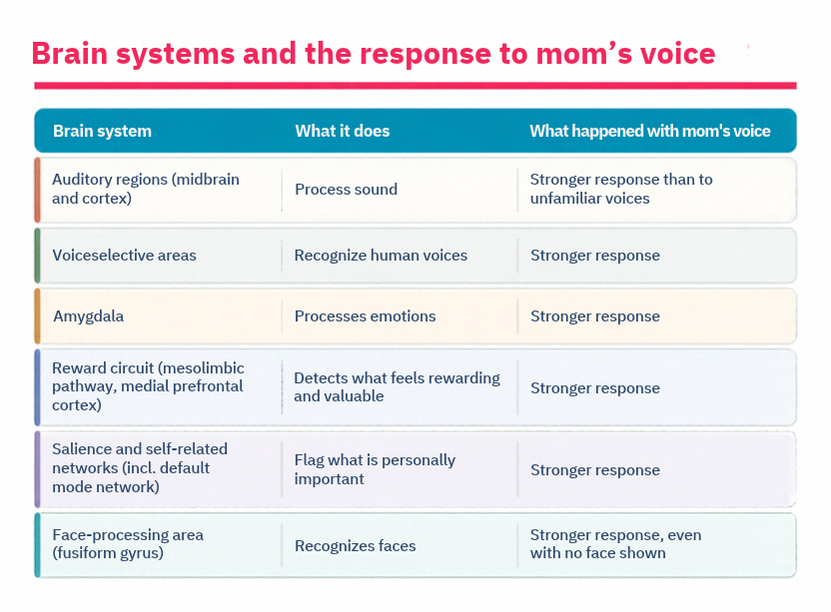
Here's the key takeaway: a mother's voice isn't processed only as a sound. The brain treats it as something emotional, rewarding, personally important, and closely linked to a familiar face.
Mom's Voice Was Recognized in Under a Second
Even from clips shorter than one second, the children identified their own mother's voice with more than 97% accuracy. That tells us how deeply a mother's voice is stored in a child's memory.
Interestingly, the researchers checked that the effect wasn't simply about a "nicer" voice. In a separate group of children, the unfamiliar voices were rated as just as pleasant as the mothers' voices. The difference came from familiarity and the relationship behind the voice, not from the sound quality.
"We didn't realize that a mother's voice would have such quick access to so many different brain systems," Dr. Abrams said.
The Link to Social Communication
The second major finding is the one that matters most for parents.
The researchers looked at how strongly the voice-processing area of the brain was "talking to" the emotion, reward, memory, and face-processing areas while children heard their mother. Children with stronger connections between these regions had better social communication scores.
The authors described this pattern as a kind of "neural fingerprint" of a child's social communication abilities. In other words, how a child's brain responds to their mother's voice may reflect how well the social parts of their brain work together.
What "Social Communication" Means
Social communication covers the everyday skills children use to connect with others, such as:
- Understanding facial expressions and tone of voice
- Taking turns in a conversation
- Noticing how someone else feels
- Joining in play and making friends
- Asking for help or expressing their own feelings
These skills don't come from one lesson. They grow slowly, through thousands of small interactions, many of which start with a familiar voice.
Why a Familiar Voice Matters So Much
Dr. Abrams put it simply: many of our social, language, and emotional processes are learned by listening to our mom's voice. The study helps explain why.
It Starts Before Birth
Babies hear their mother's voice in the womb during the last months of pregnancy. After birth, that voice becomes one of the first things linking comfort, food, closeness, and safety. Over time, the brain learns that this particular voice signals "someone important is here."
Comfort, Reward, and Attention
The study showed activity in reward and emotion areas. This fits what parents notice every day. A familiar voice can calm a child, motivate them, and pull their attention toward what matters. "We know that hearing mother's voice can be an important source of emotional comfort to children," Dr. Abrams said. "Here, we're showing the biological circuitry underlying that."
What About Dads, Grandparents, and Other Caregivers?
This study tested only biological mothers, so it can't tell us directly how a child's brain responds to a father, a grandparent, an adoptive parent, or another main caregiver. Those voices weren't measured.
Still, what the study points to is a voice that is familiar, emotionally meaningful, and connected to care. Many children grow up with more than one voice like that. Fathers, co-parents, adoptive parents, and grandparents who talk, read, sing, and comfort every day are very likely an important part of the same learning process. If you are not your child's biological mother, the practical tips below apply to you too.
Keeping the Findings in Perspective
This is a fascinating study, but it's worth being clear about what it can and can't tell us.
- It was a small study. Only 24 children took part, which is typical for brain imaging research but limits how widely the results apply.
- All children were developing typically. Results may differ for children with developmental differences, and the study did not test children with autism.
- It shows a connection, not cause and effect. Stronger brain connectivity and better social skills went together, but the study can't show that one causes the other.
- It is a snapshot. Children were scanned once, so we don't know how these brain patterns change over time.
- Only biological mothers were tested. Fathers and other caregivers weren't included.
- It measured the brain, not parenting. The study did not look at how much mothers talked to their children or how they parented.
On the other hand, the study had real strengths. It used careful brain imaging, controlled for the meaning of words, and checked that the comparison voices were just as pleasant. The authors see it as a starting point for studying social development, including in conditions such as autism, where processing of important voices may work differently.
Overall, the findings don't mean that some mothers' voices are "better" than others, or that your child's social skills depend on one thing. They do show how strongly a caring voice is woven into a child's developing brain.
Everyday Ways to Use Your Voice
You don't need special tools to put this research into practice. Your voice is already with your child every day. Here are some simple ways to make the most of it.
Talk With Your Child, Not Just To Them
Instructions like "Put your shoes on" are part of daily life, but conversation is different. Ask open questions, wait for the answer, and respond to what your child actually says. Back-and-forth talk builds both language and social skills.
Keep Reading Aloud, Even to Older Children
Many families stop reading aloud once children can read on their own. Yet hearing a parent's voice tell a story is still valuable at 9, 10, or 12. Try a chapter book you both enjoy, and use different voices for the characters.
Use Your Voice to Calm
When your child is upset, a low, slow, warm tone often works better than many words. Your voice can help your child's body settle before you talk through what happened.
Sing, Rhyme, and Play With Sounds
Songs, rhymes, and silly voices are not only for toddlers. Singing in the car, inventing rhymes, or making up a family song can be fun at any age and keeps your voice connected with joy.
Stay Connected When You're Apart
If you travel or work long hours, a short phone call or voice message can mean more than a text. For younger children, a recorded bedtime story lets them hear your voice even on nights you're not home.
Name Feelings Out Loud
Talking about emotions, both yours and your child's, teaches children to read tone and feelings. Try phrases like "You sound disappointed" or "I'm a bit tired today, so my voice is quieter."
Micro-summary: what matters most is not a perfect voice, but a present one. Warm, everyday talk and real conversation are the core of it.
Simple Voice-and-Play Activities at Home
These activities turn the study's ideas into play, and they support listening, empathy, and social communication along the way.
Guess the Voice
Record short clips of family members, friends, or grandparents saying a silly word, just like in the study. Let your child guess who's speaking. Then switch roles and let your child record voices for you to guess.
Emotion Voices Game
Say the same simple sentence, such as "We're having pasta tonight," in different emotional tones: happy, sad, surprised, angry, bored. Your child guesses the emotion. This builds the skill of reading tone, which is a key part of social communication.
Family Story Chain
One person starts a story with a sentence, and each family member adds the next part. It practices turn-taking, listening, and responding to what others say.
Record a Bedtime Story Together
Record yourself reading a favorite book, or record it together with your child, with each of you reading a part. It becomes a family keepsake and a comfort tool for nights apart.
Dinner Table Questions
Put a few question cards in a jar, for example "What made you laugh today?" or "What would you do if you were invisible for a day?" Take turns pulling a card and answering. Everyone listens, and everyone gets a turn.
Phone Call Practice
For children aged 7 to 12, calling a grandparent or relative regularly is great practice for voice-only communication: no faces, just tone, timing, and listening.
Activity Ideas by Age
.....
This table is a starting point. Every child is different, so adapt the ideas to your child's interests and personality.
When to Talk to a Professional
Every child develops at their own pace. However, it may be worth speaking to your pediatrician or a child development specialist if your child:
- Rarely responds when called by name or doesn't seem to notice familiar voices
- Has difficulty with back-and-forth conversation for their age
- Shows little interest in playing with other children
- Struggles to understand tone of voice or facial expressions
- Has lost language or social skills they used to have
Talking to a professional early is not a sign that something is wrong. It's a way to get clarity and support if you need it.
Common Mistakes to Avoid
Even with the best intentions, a few habits can work against the benefits of everyday talk.
Replacing Your Voice With Screens
Audiobooks and videos have their place, but they can't respond to your child. Real conversation, with pauses and answers, is what builds social skills.
Only Using Your Voice for Instructions and Corrections
If most of what your child hears from you is "hurry up" or "stop that," your voice can start to signal stress. Try to balance daily instructions with chats, jokes, and praise.
Talking Over Your Child
Finishing sentences or answering for your child is easy to do when you're in a rush. Waiting a few extra seconds gives them space to find their own words.
Feeling Guilty About Busy Days
No parent can talk, sing, and read all day. Short, warm moments add up. A ten-minute chat at bedtime counts.
Quick Checklist for Everyday Voice Connection
Use this list to see where your family stands:
- We have at least one real conversation every day, not just instructions
- We read aloud together a few times a week
- I use a calm, warm voice when my child is upset
- We talk about feelings openly at home
- My child hears familiar voices (calls or voice messages) when we're apart
- We play games that involve listening and taking turns
- I give my child time to answer before stepping in
You don't need to tick every box. Choose one or two ideas and build from there.
Conclusion: Your Voice Is More Powerful Than You Think
The Stanford study showed that when children aged 7 to 12 heard their mother's voice for less than a second, their brains responded across many systems, including hearing, emotion, reward, memory, self-awareness, and face recognition. Children whose brain areas worked together most strongly during this response also had better social communication skills.
The study was small and doesn't prove cause and effect, but its message is meaningful and practical. A familiar, caring voice is one of the first and most important social signals in a child's life, and it stays important well beyond babyhood.
A good first step this week: set aside ten minutes a day for a real, screen-free conversation with your child, or bring back reading aloud at bedtime. Notice how your child listens, responds, and connects. Small, everyday moments like these are where social skills grow.
Source: https://www.pnas.org/doi/10.1073/pnas.1602948113