
Online classes have quietly become one of the smartest ways to add a language, a skill or a bit of structure to a child's week, especially for international and multilingual families juggling more than one school system. Here are a few online options worth knowing about, whether you're based in Zürich, Zug or beyond.
How We Picked These
We looked for providers that are Swiss-based or well established with Swiss families and that run live sessions with a real instructor rather than pre-recorded content. We've also added two well-known international platforms at the end for families who want a broader range of subjects or a free, self-paced option to dip into alongside the rest. Each one below covers a different need, so there's no ranking here, just a set of starting points depending on what your family is after.
1. Csilla Language Lab: German Through Stories, Songs and Real Conversation
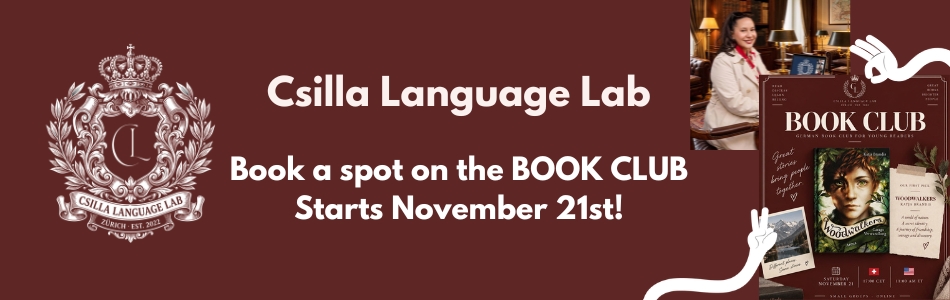
If your child needs to build German skills but a classroom setting after a full school day sounds exhausting, Csilla Language Lab runs live online classes for children aged 3 through teens (as well as adults), in private one-on-one or small group formats capped at 8 students, plus exam preparation from A1 to C2 for older students. Classes are story-based and playful rather than textbook-heavy, and the platform is used by families across Switzerland, the US and beyond, with a free trial lesson available before booking.
It's a solid option if your child is building German as a second or third language and needs consistent, low-pressure speaking practice.
2. TechSpark Academy: Coding, AI and Game Design From Home
Swiss company TechSpark Academy, which also runs in-person day camps in Geneva, Lausanne, Zug and Zürich, offers live online group classes taught by instructors studying at universities worldwide. Depending on age, kids can learn Python (from age 10 up, with separate tracks for beginner and more advanced teens), try Scratch-based Animation & Game Design (small groups, capped at 6 students), or move into teen-level courses covering AI, cybersecurity and web design.
It's a natural next step if your child has enjoyed a coding camp before and wants to keep building skills during the term, not just over the holidays.
3. HealthFirst: Online First Aid Training and Bringing Baby Home Consultations
Not every useful "online course" is aimed at your child. HealthFirst runs English-language first aid and CPR training for parents and caregivers, including Saving Little Lives (CPR and medical emergencies for babies) and First Aid for Little Ones, both offered as live online workshops as well as in person in Zurich, Zug, Bern, Lucerne and Geneva. The online CPR course runs around four and a half hours with guided hands-on practice on manikins at home, and the course fee covers two participants from the same household.
For expectant parents, HealthFirst also offers a Bringing Baby Home online consultation: a personalised 60-minute video session with American-trained pediatrician Dr Sarah Glick for up to three adults, ideally booked in the final weeks of pregnancy (32+ weeks). It covers newborn basics like feeding, sleep, safety and common early health concerns, plus time for your own questions, for a fee of CHF 150.
4. M²Mathematics: One-to-One Maths Tutoring, Online or In Person
Run by mathematician Panna Miskolczi from Erlenbach ZH, M²Mathematics offers customized one-to-one maths tutoring with flexible scheduling, available both online and in person. It covers foundational support and homework help, advanced challenges for high-achievers, and exam, test and competition preparation, including the Swiss public school system and Gymi test, IB Mathematics (Standard and Higher Level), iGCSE/GCSE and A level, as well as support for university students working with maths or other quantitative subjects.
Because it's one-to-one rather than group classes, lessons are built entirely around your child's level and pace, whether that means catching up, staying on track, or being properly challenged.
5. Outschool: Thousands of Live Classes, From One-Off to Semester-Long
Not Swiss-based, but worth knowing about for the sheer range: Outschool is a US platform offering live online classes for ages 3 to 18, taught by independent, vetted teachers, with more than 140,000 classes on offer covering everything from core academic subjects to niche interests. Classes run in small groups over video, and you can book a single one-time session to try a topic, or enrol in a longer multi-week or semester-long course, so it flexes well if your child wants to sample something new without a big commitment.
It's a good option when you're looking for a subject or interest that a local Swiss provider simply doesn't offer.
6. Khan Academy: Free, Self-Paced Learning in Core Subjects
Khan Academy is a different kind of resource: a free, nonprofit platform with no live instructor, built around short instructional videos and practice exercises that students work through at their own pace. It covers subjects from kindergarten-level maths through calculus, plus science, economics, computer programming, and arts and humanities, along with test-prep material for exams like the SAT.
Because there's no live class or schedule, it works well as a supplement alongside the other options here, for extra practice, filling a specific gap, or letting a child explore a subject independently.
What's Realistic at Each Age
Not every format suits every age, and a class that works well for an older child can be a struggle for a preschooler. As a general guide when you're weighing session length and format:
- Younger children tend to do best with shorter sessions and a parent nearby for the first few, especially in formats built around songs, stories and movement rather than sitting still and listening.
- Primary-school-aged children can typically manage longer sessions more independently once they know the routine, which is often a good age to start a first language or coding class.
- Older children and teens can generally handle longer, more structured sessions, which is also where exam-track options, like the ones M²Mathematics and Csilla Language Lab offer, start to make sense.
If a session consistently feels too long or too short for your child, it's worth asking the provider whether a different format is available before assuming online classes just aren't for them.
Two Things Worth Knowing If You're an International Family
It's one of the few things that doesn't reset when you move. Relocations, school changes, a new canton or a new country mid-year: online classes are one of the rare constants that can travel with your child through all of it. Keeping the same language tutor or the same maths teacher through a move means one less disruption in a year that already has plenty.
You get to see the lesson, not just hear about it afterward. Drop your child off at an in-person class and you find out how it went secondhand, if at all. Online, especially with a younger child, you're often in the next room, close enough to hear whether they're engaged or checked out, and many providers, like Csilla Language Lab, offer a free trial lesson so you can judge the fit yourself before deciding.
The Real Value: Consistency Without the Commute
The common thread across all of these is that they fit into real family schedules. A German class after school, a coding session on a Saturday morning, a maths hour before bed: none of it requires you to be in the car. For multilingual families in particular, this kind of consistency, showing up regularly in the same language or the same skill, tends to matter more than any single flashy programme.
Worth checking before you sign up: does your child get to speak or actively participate, not just watch? Is the group small enough that they'll be noticed if they're stuck? And does the schedule actually survive a busy week, or will it be the first thing to slip?
Explore more family activities and providers, both online and in person, on Momizen.
.jpg)